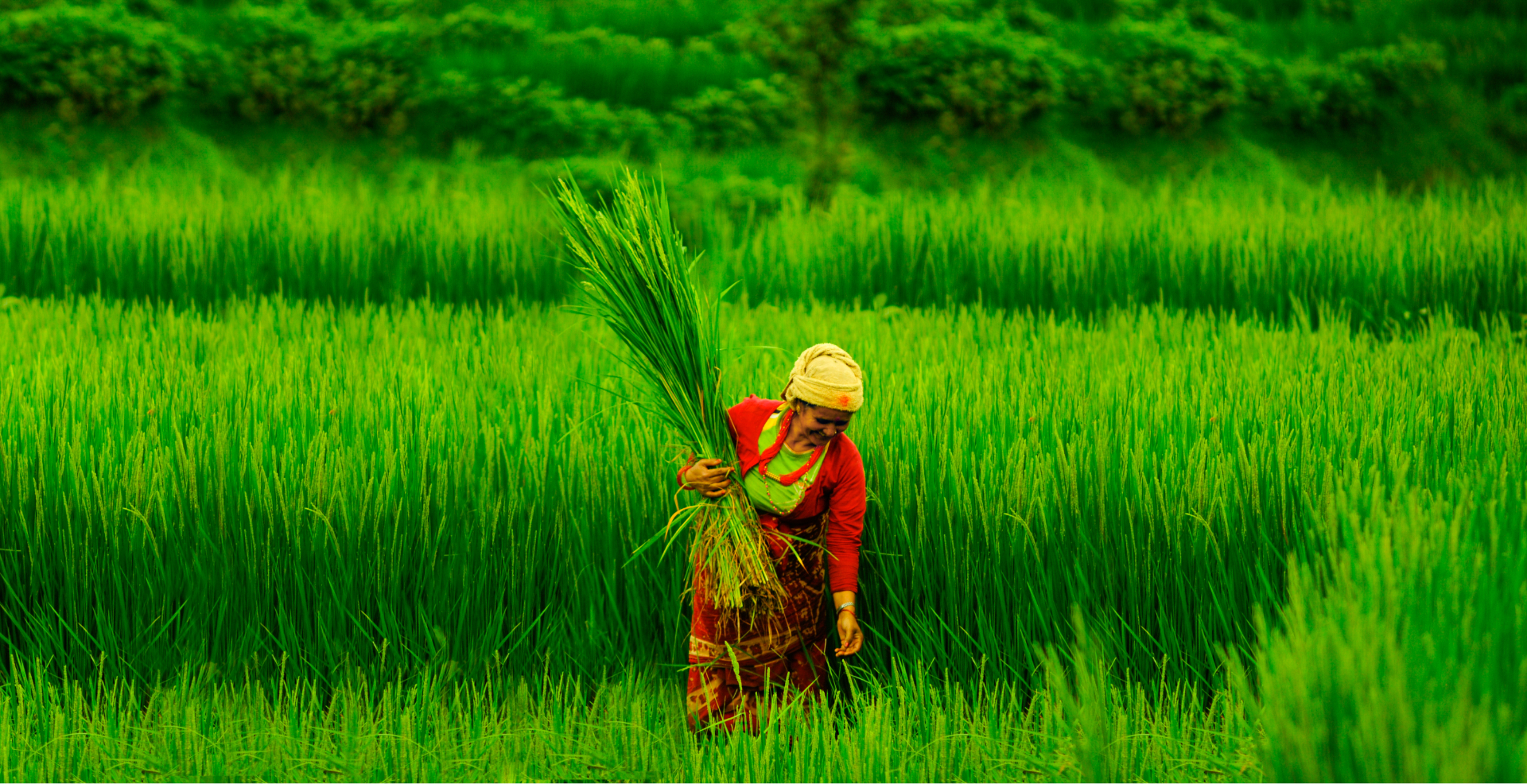
Nepal's farmers grow 70% of the country's food. Two-thirds of Nepal works the land. Most of them are one bad season from crisis. We're here to change that.
10,000 Farms helps Nepal's smallholder farmers make better decisions, using practical knowledge delivered in the language and format they can use.
Putting farming knowledge in every Nepali farmer's hands.
Free, plain-language farming tutorials built for your phone and designed for the crops you grow.
A farmer in Nepal taught herself to grow high-tunnel tomatoes using YouTube. There was no government program or extension worker, just a smartphone and the determination to learn. Her harvest improved enough that she supplemented her family's income and hired extra hands to keep up with production.
That story is why we exist. Like Khan Academy made world-class education free for anyone with an internet connection, we're building a free library of practical farming tutorials in Nepali, available whenever farmers need them.
10,000 Farms is our first milestone, not our ceiling. Our goal is to reach 10,000 smallholder farms across Nepal with trusted, practical farming knowledge. It's ambitious by design, and only the beginning of a much bigger vision.
Start with what farmers actually need. We listen, learn their decisions, their constraints, and their season, then build around that.
Every guide is visual and in Nepali. Because the best advice in the world is useless if the farmer cannot read it, trust it, or act on it in time.
Technology gets us in the door. Trust keeps us there. We work through local relationships because that is how lasting change actually happens.
The gap isn't effort. It's what farmers know.
Nepal's 2.7 million smallholder farm households produce 70% of the country's food, on plots averaging 0.6 hectares. Barely enough to feed a family. Not enough to build a future. Nearly a third of those farms are now run by women alone, managing land and family while the men who once shared that work have left for cities or foreign labor markets.
As global temperatures rise, these farmers face growing threats from drought, disease, and pest outbreaks that can wipe out an entire season. Most are already looking for ways to adapt. They just lack the tools to do it.
Nearly 72% go into debt just to plant the next season. When a crop fails, there's no safety net, only another loan. Meanwhile Nepal imports 18% of its total food bill from abroad, while the people growing food at home earn the least from it.
The land is there. The will is there. What we bring is knowledge they can trust, in their language, at the right moment in the crop cycle.
More than half of Nepal's farm households work less than 0.5 hectares. Enough to survive on. Not enough to grow a business, hire help, or absorb a bad year.
Nepal's public extension system reaches too few farmers and moves too slowly. Most rely on neighbors or traders for advice. People who may not have the right answer, or who have their own interests in what you grow.
Knowing how to grow a better crop is not enough. Middlemen exploitation, rugged terrain, and poor storage mean farmers often lose their harvest's value before it ever reaches a buyer.
In 2025, a monsoon drought cut Nepal's rice production by 10%. New pests like army worms and tomato leaf miners are spreading. For a small farmer, one bad season is not a setback. It is a debt they may never pay off.
Nepal's farmers work as hard as anyone. What changes a harvest is not effort — it is having the right information when it matters.
Low cost to reach. High trust to act.
We don't need the most advanced platform. We need a channel farmers will actually use.
Digital tools get us there cheaply. Local relationships make it stick.
- 01Listen
We start where the farmer is. What crop, what risk, what market, what phone, what language. We learn the season before we design for it.
- 02Translate
Technical knowledge only matters if a farmer can act on it. We turn research into short, visual, local-language guides for real decisions — not ideal conditions.
- 03Test
We put it in front of real farmers first. Do they understand it? Trust it? Use it? If not, it goes back.
- 04Support
Information alone isn't enough. We connect farmers to local partners and field experts so the guidance actually leads somewhere.
- 05Iterate
We learn from everyone who uses it. What landed, what got used, what changed a decision — that shapes what comes next.
The phone is already in their pocket.
Nepal has 32.4 million mobile connections in a country of 30 million people. 56% of the population is online. The channel exists. The content does not. The problem is that no one has built something worth using. We are.
For farmers not yet connected, we work through local partners and trusted community members. Because reaching every farmer matters, not just the ones with the best signal.
10,000 farm households. We start by earning the first ones.
10,000 is the goal. We're starting with zero. We won't claim farmers we haven't reached or impact we haven't measured. Progress here will update only when farmer participation is formally validated through the pilot and scale phases that follow.
That's the commitment.
- Current validated reach0 farm households
- Long-term target10,000 farm households
- StatusPhase 1
Reach numbers update only when farmer participation is formally validated. Phase 1 counts preparation, not enrollments.
Questions we get asked.
We're building a practical farming knowledge platform for Nepal.
Phase 1. We're testing what farmers need, how to deliver it, who should help deliver it, and how to measure whether it works. The 10,000-household target is the long-term ambition. We'll earn it one validated step at a time.
Knowing what to do is only the first step. Farmers also need a way to act on it and earn from it. Practical, trusted, local-language guidance can improve decision quality — but only when it is tied to real farmer constraints, local trust, and feasible action.
No. Digital-first, not digital-only. Digital tools reduce cost and improve reach; local validation, field relationships, and trusted messengers drive adoption.
Vegetables are income-sensitive and vulnerable to postharvest loss, which makes them a strong starting point for testing whether better guidance can improve farmer decision-making and future net-margin outcomes.
Universities, faculty advisors, student teams, agronomic experts, field partners, research collaborators, and funders who can help pressure-test the model before the pilot.
Agronomic content review, literature review, farmer journey mapping, measurement design, local-language learning modules, field connections, and responsible pilot planning.
The long-term North Star metric is incremental net farm margin per cultivated acre attributable to sustained adoption of validated practices, measured net of program delivery costs.
Institutions and collaborators helping shape the 10,000 Farms journey.
Additional university, research, and field partners will be listed here as Phase 1 collaborations are formalized.
We want people to challenge our assumptions.
We're not looking for endorsements. We're looking for people who will push back, tell us where we're wrong, and help us get it right before we scale.
That means agronomists who can tell us where the content is wrong. Researchers who can sharpen the measurement. Field partners who know what actually works in a Nepali village. And funders who understand that responsible impact starts before the pilot, not after.
If that's you — let's talk.
- Connect the team to farmers, extension partners, or research collaborators.
- Support literature review, farmer journey mapping, and intervention design.
- Design measurement for adoption, trust, cost per adoption, and net-margin outcomes.
- Help us make short farming videos and guides farmers can actually use.
- Review agronomic content for technical accuracy and local applicability.
- Design simple cost-and-margin tools a farmer can use without a smartphone or accountant.
We will respond within 24 hours.